How to Talk About Feelings With Your Partner (Without It Turning Into a Fight)
Updated By the BeSeen team
We make BeSeen, a couple mood journal, and mention it where it fits. How we research and write

The short answer: talk about feelings in small, frequent doses instead of one big talk. Name one feeling as yours (“I felt left out tonight”), pick a calm moment, say what would help, and stop for a while if either of you gets flooded. When it is your turn to listen, show you heard before you respond. None of this takes courage. It is mechanics, and mechanics can be practiced.
“We need to talk” might be the most counterproductive sentence in a relationship. It schedules a confrontation, puts both of you on alert, and guarantees the conversation starts with one person braced. Most couples don’t avoid talking about feelings because they don’t care. They avoid it because every attempt seems to either fizzle into “I’m fine” or escalate into a fight about something else entirely. This guide covers both sides: how to say it, and how to hear it.
Why is talking about feelings so hard?
Talking about feelings is a skill, not a personality trait. Most of us got zero training, and plenty of us got anti-training: households where feelings meant conflict, or where naming a need was treated as weakness. If that’s you or your partner, difficulty isn’t a red flag about the relationship. It’s a starting skill level, and skills respond to practice.
It is worth the practice, because feelings are the part of sharing that builds closeness. In a pair of diary studies, people rated how intimate each of their social interactions felt over one to two weeks. Sharing emotions predicted intimacy more strongly than sharing facts and information in the second study, and feeling that the other person responded well explained part of the link (Laurenceau, Barrett and Pietromonaco, Journal of Personality and Social Psychology, 1998). Those were everyday interactions, not only couples, but the pattern is familiar: telling your partner your day was “long” keeps them informed, and telling them you felt invisible in a meeting lets them in.
Keeping it in has a cost, too. In two lab studies at Stanford, pairs of women who had not met before discussed an upsetting topic. When one was told to hide her emotions, the conversation went worse and her partner’s blood pressure rose more (Butler et al., Emotion, 2003). Strangers in a lab are not a couple at home, so read it as a hint rather than a rule: holding a feeling back is rarely as invisible as it seems.
Shrink the dose
The couples who talk about feelings easily almost never do it in big conversations. They do it in tiny, frequent ones. Naming an emotion while it’s small, “I’m a little anxious about tomorrow,” costs thirty seconds and lands softly. The same feeling, compounded for three weeks, arrives as “you never support me.”
Psychologists call putting a feeling into words affect labeling. In a UCLA brain-imaging study, naming the emotion in an upsetting image dampened the amygdala’s response (Lieberman et al., Psychological Science, 2007). That was a lab study, not a study of couples, but it fits what couples report. The daily version of this is a short ritual we’ve written about in detail in the daily relationship check-in. A mood, one line of why, done. Practiced daily, the big scary talk mostly stops being necessary, because nothing gets three weeks to compound.
Find the word before you say it
Half of what goes wrong in a feelings talk happens before anyone speaks: the feeling arrives as a vague “bad” or “stressed,” and your partner has to guess what it means. They guess wrong, offer a fix for the wrong problem, and now you feel unheard on top of whatever you felt before.
Researchers call the ability to tell similar feelings apart emotion differentiation, or emotional granularity. A review of the research found that people who describe their distress in more precise terms are less likely to cope in harmful ways, such as drinking heavily or lashing out, and that early evidence suggests the skill can be trained (Kashdan, Barrett and McKnight, Current Directions in Psychological Science, 2015). That work looks at individuals, not couples, but a precise word also does something simple for your partner: it tells them what kind of help you want.
| Instead of | Try one of |
|---|---|
| Bad | Drained, dreading, embarrassed, lonely, on edge |
| Stressed | Behind, cornered, stretched thin, scared of letting someone down |
| Annoyed | Ignored, taken for granted, interrupted, disappointed |
| Fine | Flat, tired but okay, quietly content, not ready to talk yet |
| Good | Relieved, proud, close to you, light, looked after |
You don’t need a feelings wheel on the fridge. Before you speak, ask yourself one question: if this feeling had a more exact name, what would it be? “Ignored” asks for attention. “Behind” asks for help with the load. “Lonely” asks for time together. Each points to a different next step.
Sentence starters that don't start fights
The pattern behind every good opener: name the feeling, own it as yours, and separate it from blame. Gottman calls this a softened start-up, and his research found that conversations tend to end on the same note they begin (The Gottman Institute). A few openers that work:
- “I noticed I've been off since Tuesday, and I think it's about work, not us.”
- “I'm not looking for a fix, I just want you to know today was heavy.”
- “Something small bothered me earlier and I'd rather say it now than let it grow.”
- “I don't have the exact words yet. Can I think out loud for a minute?”
- “On a 1 to 10, today was a 4. Ask me about it after dinner?”
- “I felt left out at dinner with your friends. Can we talk about it tomorrow?”
Notice what’s missing: “you always,” “you never,” and “why do you.” The moment a feeling is phrased as a charge sheet, the conversation becomes a trial. “I feel” followed by an emotion, not “I feel like you always,” keeps it information. If you have a request, make it small and concrete: “Could you text me when you’re running late?” is something a person can say yes to. “I need you to be more considerate” isn’t.
Timing is half the conversation
The same sentence lands completely differently at different moments. Three timing rules cover most of it:
- Not mid-conflict. Feelings named as ammunition don’t count as vulnerability. Wait until you’re both calm, then name what happened.
- Not at the door. The first ten minutes after work are a decompression chamber, not a conversation slot.
- Do it on a schedule. A standing nightly check-in means nobody has to build the courage to initiate, because nobody is initiating. The slot exists, and honesty just fills it. For the bigger things, a weekly check-in gives them a set time too.
How should you listen when your partner opens up?
Most advice on this topic is about speaking, but the listener decides whether anyone tries again. If sharing a feeling gets you a lecture, a fix you didn’t ask for, or a quick change of subject, you learn to stop sharing.
One line of research looks at what happens when people share good news. Partners who respond with real interest, asking questions and sharing the excitement, rather than a distracted “nice” or a reason to worry, were linked with more intimacy and higher daily satisfaction in the relationship (Gable et al., Journal of Personality and Social Psychology, 2004). Those studies were about good news, and they show an association, not proof of cause, but the habit carries over to hard feelings well. What it looks like in practice:
- Say back what you heard. “So it wasn’t the deadline, it was being talked over in front of everyone.” If you got it wrong, they will correct you, and that is progress.
- Ask one question before you offer anything. “What was the worst part?” or “Do you want ideas, or do you want me to just listen?”
- Don’t defend yourself in the first minute. If the feeling is about you, you will get your turn. Hearing them out first is what makes your turn possible.
- Notice the small bids. Gottman’s newlywed research, as described by his institute, found that couples still married six years later had turned toward each other’s bids for attention 86% of the time, against 33% for couples who divorced (The Gottman Institute). A sigh, a “guess what,” a link sent mid-afternoon: these are small requests to be noticed.
When those small moments keep getting missed, the result is a particular kind of loneliness inside a relationship. We wrote about it in feeling unseen in a relationship, including how to raise it without it sounding like an accusation.
What if your partner shuts down or says "I'm fine"?
If your partner goes quiet when feelings come up, the instinct is to push harder, and pushing is exactly what keeps the door shut. Shutting down is usually overwhelm, not indifference.
What helps: lower the stakes and lengthen the runway. Ask smaller questions, “was today more draining or more okay,” instead of “what are you feeling.” Accept short answers without prosecuting them; “drained” is a complete answer, and being thanked for it is what earns you the longer one next week. Side-by-side conversations, on a walk or in the car, reliably beat face-to-face interrogation lighting. And give them the question in advance when you can: some people need an hour with “what do you need from me this week” before there’s an answer.
Two situations deserve their own playbook. If the problem is a single word that ends every conversation, read what to do when your partner says “I’m fine”: what the word can mean, and the easier questions to ask instead. If it is a longer pattern, a partner who rarely says how they feel at all, start with when your partner doesn’t share their feelings, which covers the usual reasons and why going first yourself works better than asking harder.
What to do when it turns into a fight
Sometimes it goes wrong anyway. Voices rise, someone brings up last Christmas, and the original feeling is buried. There is a physical reason that happens. The psychologist John Gottman calls it flooding and writes that once your heart rate passes about 100 beats a minute, you can’t take in what your partner is saying, however hard you try (The Gottman Institute). Past that point, more talking only adds damage.
- Call the pause, and say when you’ll be back. “I’m too wound up to listen well. Can we pick this up after dinner?” A pause with a return time is a break. Without one, it feels like walking out.
- Calm down for real. The same Gottman piece suggests around twenty minutes of something relaxing, without rehearsing your case in your head.
- Come back to the feeling, not the fight. Start again from the original “I felt left out,” not from the worst thing either of you said at minute nine.
- Repair out loud. “I was sharp earlier, and I’m sorry” costs little and resets more than a perfect argument would.
How do you know how your partner is really feeling?
From the outside, you can’t, at least not reliably. People hide a hard week well, and a quiet evening can mean contentment as easily as distance. Signs like unprompted affection or making plans tell you when to ask, not what the answer is. Our guide to how to know if your partner is happy goes through the signs worth noticing and how to ask without it becoming an interrogation.
The more dependable route is to make knowing routine instead of detective work. If each of you shares a mood and a line of why most days, you stop guessing, and a change in the pattern shows up early, while it is still a small conversation.
Talking about feelings when life is loud
Feelings run highest exactly when there is least room to talk about them. Three situations come up again and again:
- Family seasons. Holidays bring travel, in-laws and old roles, and very little privacy. Agree before you go on how either of you can step out, and keep a short daily check-in going while you’re there. Surviving the holidays as a couple covers the planning.
- A rough patch. When most conversations feel hard, it is tempting to stop having the feelings ones. That is usually when they matter most. If you are wondering whether this is a hard stretch or an ending, rough patch or time to break up walks through how to tell, and when a counselor is worth it.
- Distance. Apart, you lose the face and the tone that carry half of what a feeling means, so naming it in words matters more. Our long-distance rituals build that into the day.
One limit applies to everything on this page. If you are afraid of your partner, or a conversation about feelings has ever ended in threats or being hurt, this is not a communication problem and better wording will not fix it. In the US, The Hotline is available 24 hours a day at 800-799-7233 or at thehotline.org.
When writing works better than talking
For a lot of people, especially the ones who shut down out loud, feelings come out cleaner in writing. There’s no one watching your face while you find the words, no interruption mid-sentence, and you can edit “you ruined the weekend” into “I felt invisible on Saturday” before anyone reads it.
Writing about emotions has a long research record of its own. A review by the psychologist James Pennebaker summarized a decade of studies in which people who wrote about emotional experiences showed improvements in physical and mental health (Pennebaker, Psychological Science, 1997). Those studies asked people to write about their own experiences, not to message a partner, so they say more about finding the words than about sharing them. That is still the hard part for many people. If that sounds like your household, these 45 couples journal prompts are a gentler on-ramp than any sit-down talk.
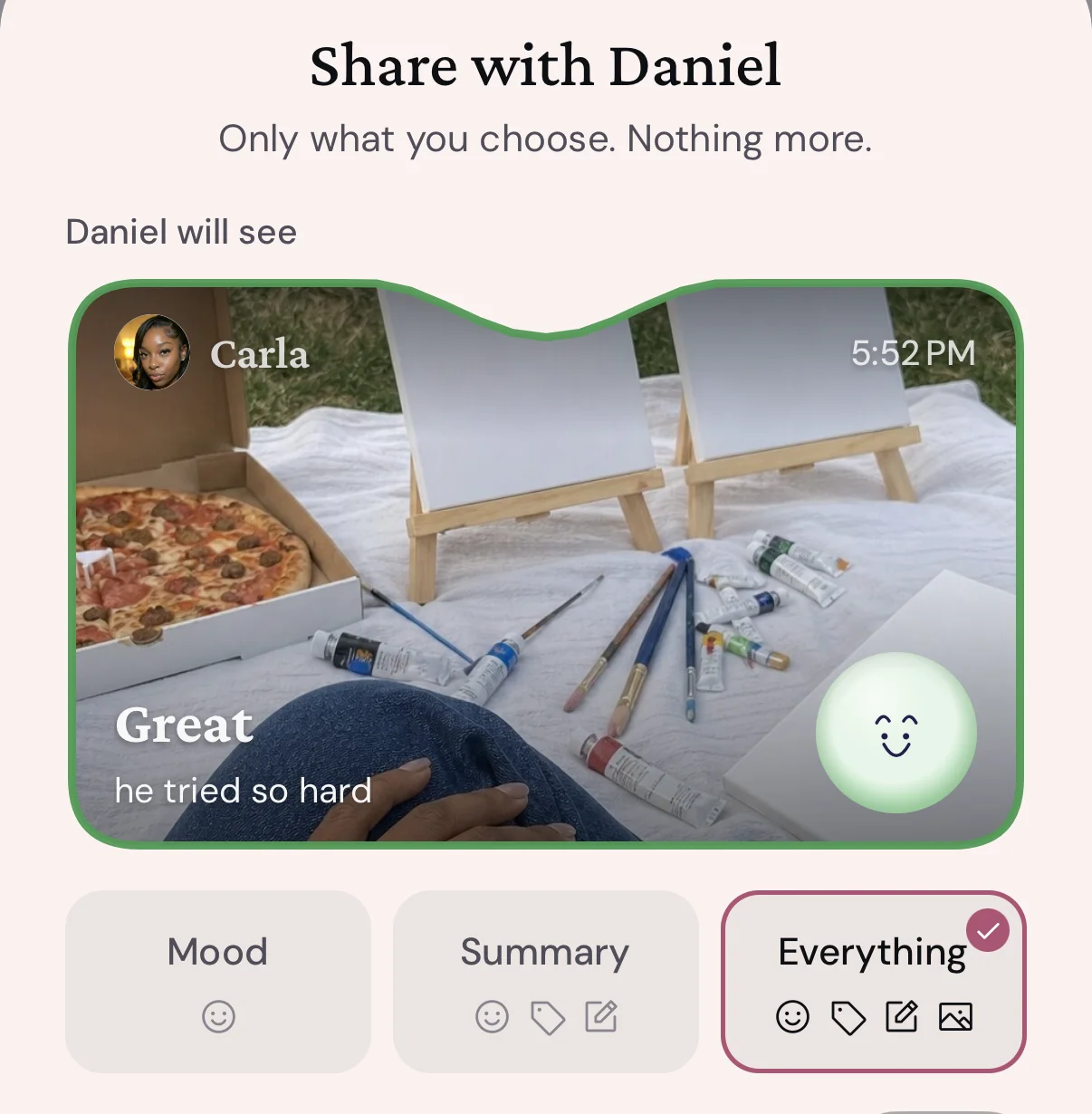
In BeSeen
Say how you feel, and choose how much
In BeSeen you check in with a mood and a line of why in about thirty seconds, then pick what your partner sees: just the mood, a summary, or everything. The talking gets easier when it isn’t the only way in.
Try it free on iPhoneCommon questions
How do I start a conversation about feelings with my partner?
Start small and specific, name the feeling as yours, and leave out blame. "I've been off since Tuesday, and I think it's work, not us" opens a door; "we need to talk" puts both of you on guard. Pick a calm moment, not the minute one of you walks in the door.
Why does my partner shut down when I bring up feelings?
Shutting down is usually overwhelm, not indifference. Smaller questions, short answers accepted without pushing, and side-by-side talks on a walk or in the car tend to help more than pressing harder.
What should I do if a conversation about feelings turns into a fight?
Pause and come back later. Gottman's work on flooding suggests that once your heart rate is high, neither of you can really listen. Say when you will come back, take at least twenty minutes doing something calming, then return to the same topic.
How often should couples talk about feelings?
Briefly and often works better than rarely and at length. A two-minute check-in most days, a mood and one line of why, keeps small feelings small, and a longer weekly conversation can cover what the daily ones surface.
What if I don't know what I'm feeling?
Say that. "Something's off and I can't name it yet" is honest and useful. It can help to start with your body (tight chest, tired, restless) and then try two or three specific words until one fits.
Is it okay to share feelings by text or in writing?
Yes. Writing gives you time to find the words and no face to react mid-sentence, which helps people who freeze up out loud. Use it as an opener for talking, not a replacement for it.
Say how you feel in thirty seconds, even on the quiet days.
BeSeen is a couple mood journal for iPhone. Free to try; partner features need an account.
Get BeSeen on the App Store