My Partner Doesn’t Tell Me How They Feel: What to Do Instead of Pushing
Updated By the BeSeen team
We make BeSeen, a couple mood journal, and mention it where it fits. How we research and write

A partner who does not talk about feelings is common, and it is not the same as a partner who does not have them. What tends to help is making it smaller rather than bigger: go first, ask a small question instead of a big one, and make it a regular habit where any answer, including “skip”, is accepted.
You ask how they are and get “fine”. You ask what is wrong and get “nothing”. You have tried patience, you have tried pushing, and you are starting to wonder whether they feel anything at all, or whether they just do not want to tell you. This is one of the most common problems in long relationships and one of the most fixable, as long as you stop doing the thing that feels most natural.
First, rule out the obvious
Before you read this as a pattern, check three things. Are they exhausted? Feelings are the first thing to go when someone has nothing left. Is there a specific event, a job, a death, a diagnosis, that they have not processed yet? And are you asking at a time when anyone would deflect: in front of the kids, in the car outside the party, right before sleep? If any of these is true, the fix is time and timing, not technique.
Why do some people go quiet?
A partner who does not share feelings is almost never a partner who does not have them. The reasons cluster into a few kinds, and it helps to know which one you are living with.
- They were never shown how. Plenty of adults grew up in homes where feelings were handled by not mentioning them. They are not withholding; they do not have the words yet, and being asked for them feels like a test they will fail.
- The last few times went badly. If sharing a feeling ever turned into a fight, a lecture, or a fix-it plan, the lesson learned was that sharing costs more than it gives. People stop doing things that cost them.
- They process slowly. Some people know how they feel in the moment. Others find out two days later in the shower. Asking a slow processor "what are you feeling right now" gets a shrug because the honest answer is "I don't know yet".
- They think it is protecting you. Stress at work, money worry, a health scare. A lot of quiet partners are carrying something on purpose so you do not have to. It is misguided and it is loving, and both things are true.
- They do not feel safe enough yet. Not safe from you, necessarily. Safe from being wrong, being too much, or being remembered at their worst. That kind of safety is built in small, boring deposits, not in one big talk.
The mistake almost everyone makes
You ask a bigger question. When “how are you?” gets “fine”, the instinct is to escalate: “no, how are you really?”, “we need to talk”, “why can you never tell me anything?”. Every one of those raises the stakes of answering, and a person who went quiet because answering felt risky will go quieter. You end up in the loop where your need to know makes them less able to tell you. Run that loop long enough and the one asking starts feeling unseen, which raises the stakes again.
Pushed hard enough, some people stop responding at all. The Gottman Institute calls this stonewalling and describes it as what happens when a person feels overwhelmed or physically flooded: heart rate up, stress hormones released, no room left to think. Their advice is a break of at least twenty minutes before trying again (The Gottman Institute). A partner who goes blank mid-conversation may not be refusing you. They may be flooded.
The second mistake is fixing. If the one time they did open up, you responded with a plan, they learned that feelings summon a project. Most people would rather keep the feeling than get the project.
What works instead
Three moves, and they are all about making it smaller. First, shrink the question: not “how do you feel” but “heavy or light today?”. Second, go first, every time, with a real answer of your own; sharing is reciprocal and you cannot ask for what you are not giving. Third, accept whatever comes back, including nothing, without a follow-up. The follow-up is the pressure. If a one-word answer is met with “okay, thanks for telling me” and nothing else, the next one-word answer comes easier, and the fourth or fifth one comes with a sentence attached.
Side by side beats face to face for this. Walking, driving, cooking, lying in the dark. Eye contact is intimacy for people who are comfortable; for people who are not, it is a spotlight. The same goes for the bigger question of whether they are happy; our guide on how to know if your partner is happy has words for asking it.
What to say, word for word
Say these as written. The ending is the important part: every one gives them permission not to answer.
Taking the pressure off
“You do not have to explain anything. I just want to know whether today was heavy or light. One word is enough.”
Offering a way in
“I noticed you went quiet after the call. I am not going to make it a thing. If you want to tell me later, I am here; if not, that is okay too.”
When they say they do not know
“That is a real answer. Can I ask again on Sunday, when it has had time to settle?”
Going first
“I will go first. Today I was about a six, mostly because of work. Where were you?”
Make it lower stakes than talking
Here is the thing that surprises people: many quiet partners will happily tap a mood on a screen that they would never say out loud. Writing “tired, overwhelmed” and choosing to let you see it is a much smaller act than saying it to your face and watching your reaction. Naming a feeling can also help the person naming it: in a brain-imaging study led by Matthew Lieberman, putting a feeling into words dampened the amygdala’s response to emotional images (Psychological Science, 2007). It is not a replacement for talking. It is the on-ramp, because once you already know it was a heavy day, the conversation can start from “I saw” instead of “what is wrong”.
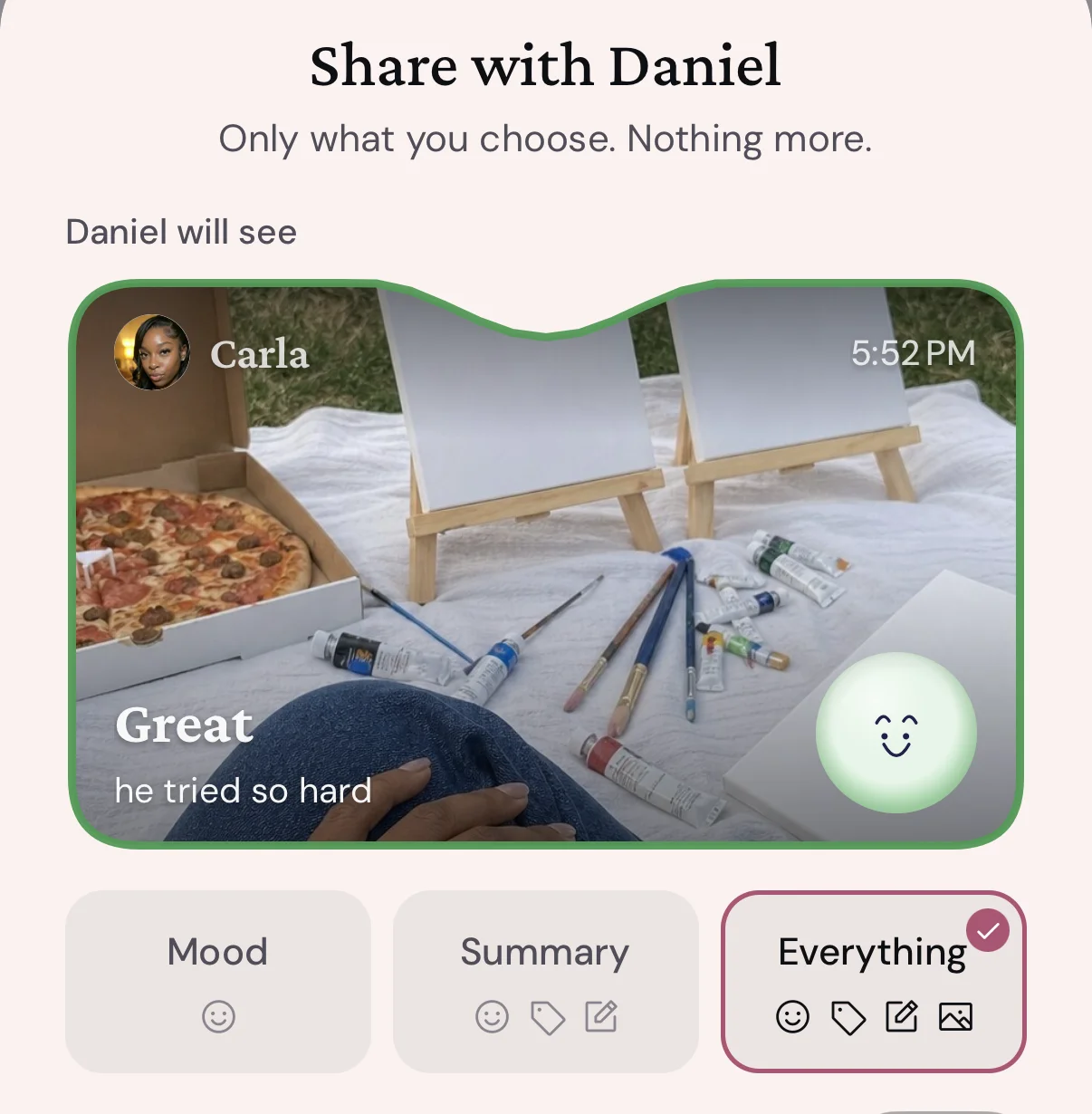
In BeSeen
They choose how much you see
In BeSeen, each of you checks in with a mood and the feelings behind it in about thirty seconds, then picks what the other sees for that check-in: just the mood, a summary, or everything. For a partner who hates being asked, it is often the first place the real answer shows up. The solo journal needs no account, so you can start on your own and invite them when it feels right.
Try it free on iPhoneOur guide to the daily relationship check-in covers how to run the same ritual without an app.
When is silence a warning sign?
Quiet is a skill gap most of the time. It is something else when it arrives suddenly in someone who used to share, comes with withdrawal from friends and things they enjoyed, changes in sleep or appetite, or a flatness that does not lift on good days. Those can be signs of depression (the US National Institute of Mental Health lists the common ones), not of a communication style, and the right move is to say plainly that you have noticed and to offer to help them find someone to talk to. Silence used as punishment, the days-long freeze that ends only when you apologise for something you did not do, is a different problem again and worth raising with a counsellor.
Common questions
Why does my partner shut down when I ask how they feel?
Usually because the question arrives as pressure: a big open question, in the moment, with an expectation of a real answer. Shutting down is what people do when they feel tested. Smaller questions, asked side by side, with an explicit option to pass, get more than direct ones.
Is it normal for my partner to not talk about feelings?
It is common, and it is not the same as not having them. Many people were raised without the vocabulary or learned that sharing costs them. The relevant question is whether they are willing to build the skill slowly, not whether they have it today.
How do I get my partner to open up without pushing?
Go first, make the unit small, and make it regular. A daily one-word check-in that you both answer, where any answer including "skip" is accepted, builds the habit in a few weeks. Pushing in the moment reliably does the opposite.
Should I stop asking altogether?
No. Stop asking the big question and keep asking a small one. Silence from you reads as not caring, which confirms the reason they went quiet in the first place.
Give them a way to tell you that is smaller than a conversation.
BeSeen is a couple mood journal for iPhone. Free to try; partner features need an account.
Get BeSeen on the App Store