The Daily Relationship Check-In: A 5-Minute Ritual That Actually Sticks
Updated By the BeSeen team
We make BeSeen, a couple mood journal, and mention it where it fits. How we research and write

A daily relationship check-in is a few minutes each day where you both say how you are: a mood, one line of why, and sometimes one shared question. It’s a habit, not a meeting, and it works because small feelings are easier to name before they build up.
Most couples don’t drift apart over something big. They drift in the gap between “how was your day” and “fine”, repeated a few hundred times.
A daily check-in closes that gap. Not a therapy session, just a small, repeatable moment where you both say how you actually are. Couples who do it stop being surprised by each other’s bad weeks, because they watched them build in real time.
Here’s how to start one that survives past the first enthusiastic week.
Why daily beats the big talk
The monthly state-of-the-union conversation has a flaw: by the time it happens, small things have compounded into resentments with interest. A Tuesday irritation that would have taken thirty seconds to name now arrives three weeks later as “you always do this.”
Daily check-ins work because the stakes stay low. Naming a feeling while it’s small is easy. Psychologists call putting a feeling into words affect labeling. In a brain-imaging study at UCLA, naming the emotion in an upsetting photo dampened the amygdala’s response compared with other ways of processing it (Lieberman et al., Psychological Science, 2007). That was a lab study with pictures, not couples, but the idea travels. “I’m fine” names nothing. “I’m drained and a little anxious about tomorrow” names it, and it hands your partner a map instead of a mystery.
What do you say in a daily check-in?
Keep it small enough that you can do it exhausted, because some nights you will be.
A mood, honestly
One word or one tap. “Low” is a complete answer.
~10 seconds
One line of why
“Work was relentless and I skipped lunch” is plenty.
~30 seconds
One question, both of you
Same question, two answers, side by side.
~2 minutes
1. A mood, honestly. One word or one tap. Not the mood you think your partner wants to see. “Low” is a complete answer.
2. One line of why. Not a journal entry. “Work was relentless and I skipped lunch” is plenty. The why is what turns a mood from data into a person. Save the longer writing for the nights you want it; our journal prompts for couples are sorted by the kind of night you are having.
3. One question, both of you. The same question, answered by both. Specific beats broad: “what’s one small thing that made you smile today” will outperform “how are we doing” every single time. (We keep 60 of them here, sorted from easy to deep.)
That’s it. Two to five minutes.
When and where should you check in?
Attach it to something you already do, don’t rely on remembering. The strongest anchors:
- In bed, lights low. The classic. The day is over, so the report is complete.
- The commute call, if you’re long-distance or on opposite schedules.
- After dinner, before screens win. Good for couples whose evenings evaporate.
Same time, same place, most days. Missing a day is fine; missing a week means the anchor is wrong, so move it rather than trying harder.
The rules that keep it safe
A check-in dies the first time honesty gets punished. Three rules protect it:
- A mood is information, not an accusation. “Frustrated” doesn’t mean frustrated at you. Ask before assuming.
- No fixing unless asked. The check-in is for being heard. Solutions are a separate, opt-in conversation.
- Low days are allowed. If every “meh” triggers an interrogation, the honest answers stop. Sometimes the right response is just “thanks for telling me” and a longer hug.
Long-distance couples: this is your lifeline
Distance removes all the ambient information, the sigh from the kitchen, the tired shoulders at the door. A daily check-in puts a structured version of it back. Many long-distance couples find the check-in becomes the anchor point of the day, a fixed moment of “we happen now” regardless of time zones.
Making it stick
The honest failure mode isn’t unwillingness, it’s logistics. Whose turn to ask, what question, did we do it yesterday. The ritual dies of friction.
So take the logistics off the table: same anchor every night, the same three steps, and a question you didn’t have to pick.
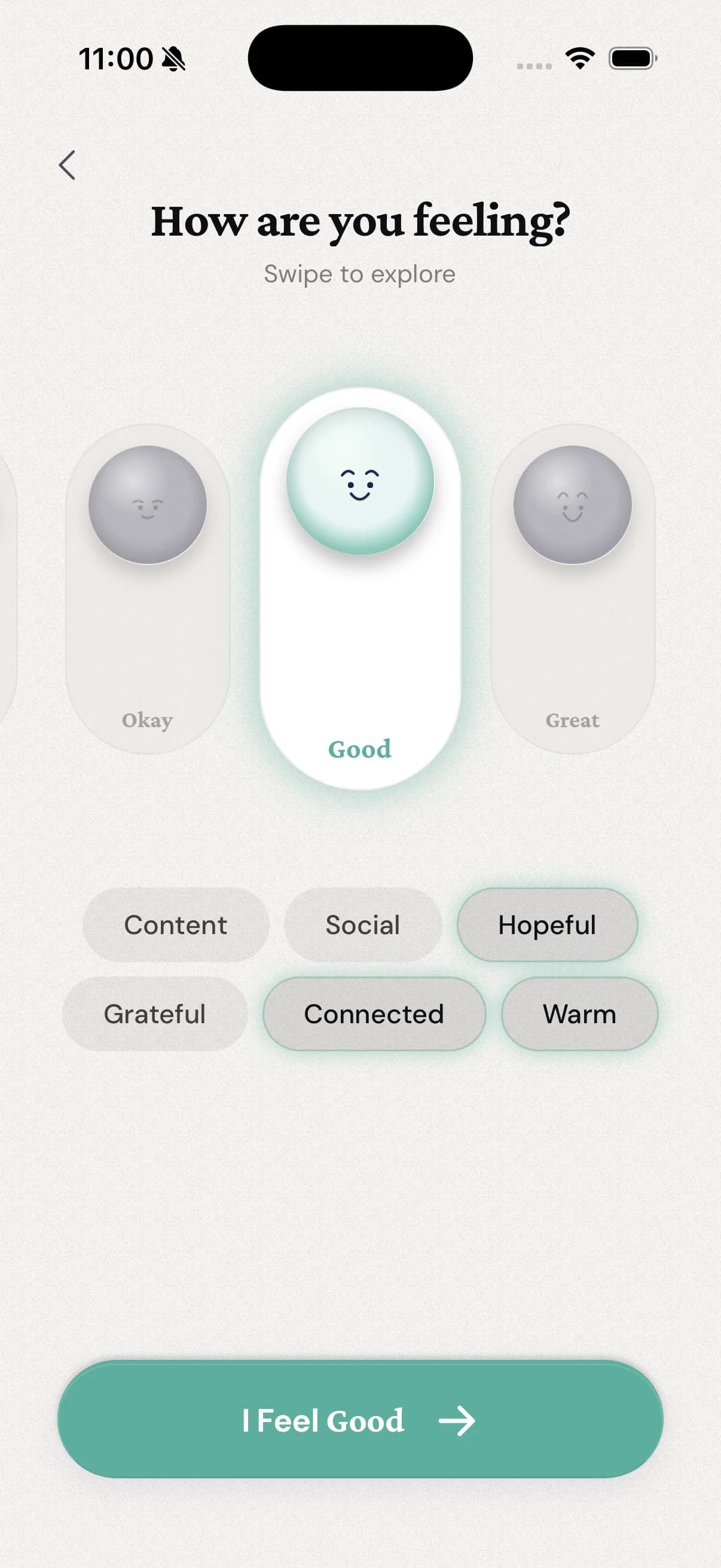
In BeSeen
The whole check-in in about thirty seconds
In BeSeen you pick a mood from Heavy to Great, add emotion tags or a quick note, photo, or voice memo if you want, and choose what your partner sees: just the mood, a summary, or everything. Their shared mood shows up on your home-screen widget.
Try it free on iPhoneCommon questions
What is a daily relationship check-in?
A short, repeatable moment each day where both partners say how they actually are: a mood, one line of why, and sometimes one shared question. It's a habit, not a meeting, and it takes a few minutes.
What do you say in a daily check-in with your partner?
Say your mood honestly, add one line about why, then answer one question together. "Low, work was relentless" is a complete check-in.
Is a daily check-in better than a weekly one?
They do different jobs. A daily check-in catches small things before they grow; a weekly one leaves room for planning and bigger topics. Many couples do a quick daily one and a longer weekly one.
What if my partner doesn't want to do a check-in?
Keep it tiny and optional, go first yourself, and thank them for short answers instead of pressing for more. A ritual that feels like an evaluation won't last.
Can long-distance couples do a daily check-in?
Yes, and it often matters more at a distance, because it replaces the everyday cues you'd pick up in person. It works across time zones if each of you checks in on your own evening and reads the other's when you wake.
Check in tonight. It takes about thirty seconds.
BeSeen is a couple mood journal for iPhone. Free to try; partner features need an account.
Get BeSeen on the App Store