The Weekly Relationship Check-In: A 20-Minute Agenda, Questions and Rules
Updated By the BeSeen team
We make BeSeen, a couple mood journal, and mention it where it fits. How we research and write

A weekly relationship check-in is a fixed twenty-minute conversation, same night every week, with four parts: appreciations, one hard thing each, the week ahead, and a close. It is not a therapy session and not a performance review. It is the slot where small things get said while they are still small, so they never arrive three weeks later as “you always do this.”
The format is adapted from the weekly “State of the Union” meeting that the Gottman Institute teaches couples, which also opens with appreciations before any issue is raised. Their reason is the same one behind this page: unspoken things “build up over time and lead to either big fights or distance” (The Gottman Institute).
Below is the agenda, the questions for each part, the rules that keep it safe, and the honest reasons most couples quit by week four.
The 20-minute agenda
0–3 min
Arrive
Phones away. One word each for how you are walking in. No discussion yet.
3–8 min
Appreciations
Two things each that the other person did this week that you noticed. Specific, not “thanks for everything.”
8–15 min
The one thing
Each of you names one thing that was hard this week, about the relationship or not. The other person asks questions and does not fix.
15–18 min
The week ahead
Logistics, in two minutes: the late nights, the visit, the money thing. Put it on a calendar and stop talking about it.
18–20 min
Close
One thing you are looking forward to together. Then something physical: a hug, a walk, the couch.
The order matters. Appreciations first, so the hard thing lands on a cushion. That is not only manners: in a study that followed couples day by day, feeling grateful after a partner’s kindness predicted feeling more connected and more satisfied the next day, for both partners (Algoe, Gable and Maisel, Personal Relationships, 2010). Logistics near the end, so the check-in does not become a calendar meeting with feelings bolted on. The close is not optional; it is what makes next week’s check-in something you want.
The questions, by section
Pick one or two from each section. Asking all of them is how the check-in grows to an hour and dies. For a much bigger bank, sorted from easy to deep, see our 60 couple check-in questions. If one of you would rather write the hard thing down first, our couples journal prompts include a set for repair after a rough week.
Appreciations
- What did I do this week that made you feel loved?
- What is one small thing I did that you noticed and did not mention?
- When did you feel most like a team this week?
The one thing
- What was the hardest part of your week, and did I see it?
- Is there anything you have been holding in that we should talk about?
- Was there a moment this week when you felt unseen or misread?
- What do you need more of from me next week? What do you need less of?
Us
- What is working in our relationship right now that we should protect?
- What is one thing we keep putting off that we should decide on?
- On a scale of one to five, how connected did you feel to me this week? What would have made it one higher?
The week ahead
- What is coming up that you are dreading, and how can I help?
- When are we going to have time that is just ours?
- Is there anything on the calendar we need to say no to?
The rules that keep it from becoming a fight
- One hard thing each, not a list. The week’s biggest one. The rest can wait or were not that big.
- Questions before solutions. When your partner names something hard, ask two questions before offering anything. Most of the time being asked is the fix.
- Say it as information about you. “I felt alone on Tuesday” opens a door. “You ignored me on Tuesday” closes it.
- No new grievances after the close. If it did not make the check-in, it waits for next week or becomes a separate conversation you both agree to have.
- A bad check-in is still a check-in. Some weeks it will be tense. Ending on time and hugging anyway is what makes the habit trustworthy.
The first minutes carry the most weight. In a study of 124 newlywed couples, how the first three minutes of a disagreement went predicted whether they were still married six years later (Carrère and Gottman, Family Process, 1999). That is why the hard thing comes after appreciations, and why it is said as information about you.
Why weekly, and why it fails
Weekly is the right cadence for decisions and resentment. Both accumulate slowly, and both get expensive if left for a month. It is the wrong cadence for moods, which change daily, which is why the weekly check-in works best on top of a daily one.
Why it fails, in order of frequency: it is not on the calendar, so it happens when someone remembers, which is usually mid-argument. One partner treats it as a review of the other. It runs long, so it starts to feel like a chore. Or it goes well for three weeks, one gets skipped, and the skip becomes the new pattern. The fixes are boring: a fixed slot, a timer, one hard thing each, and a rule that a missed week is rescheduled within two days rather than dropped.
Daily check-in vs weekly check-in
| Daily check-in | Weekly check-in | |
|---|---|---|
| Takes | Under a minute | About twenty minutes |
| Answers | How are you, right now | How are we, this week |
| Best at | Catching a bad day before it becomes a bad week | Deciding things and clearing resentment |
| Fails when | It turns into an interrogation | It turns into a performance review |
| Needs | A place to log it: a note, or an app your partner can see | A fixed slot, and the daily data to look back on |
The daily version, a mood and one line of why, takes under a minute and gives the weekly check-in something to look back on. “You were low Tuesday to Thursday, what was that?” is a better opener than “how was your week.” The daily ritual is in our daily relationship check-in guide. Kept for a few weeks, those daily moods add up to a mood tracker for the two of you; that guide covers what to log and what to leave out.
In BeSeen
The week, already laid out
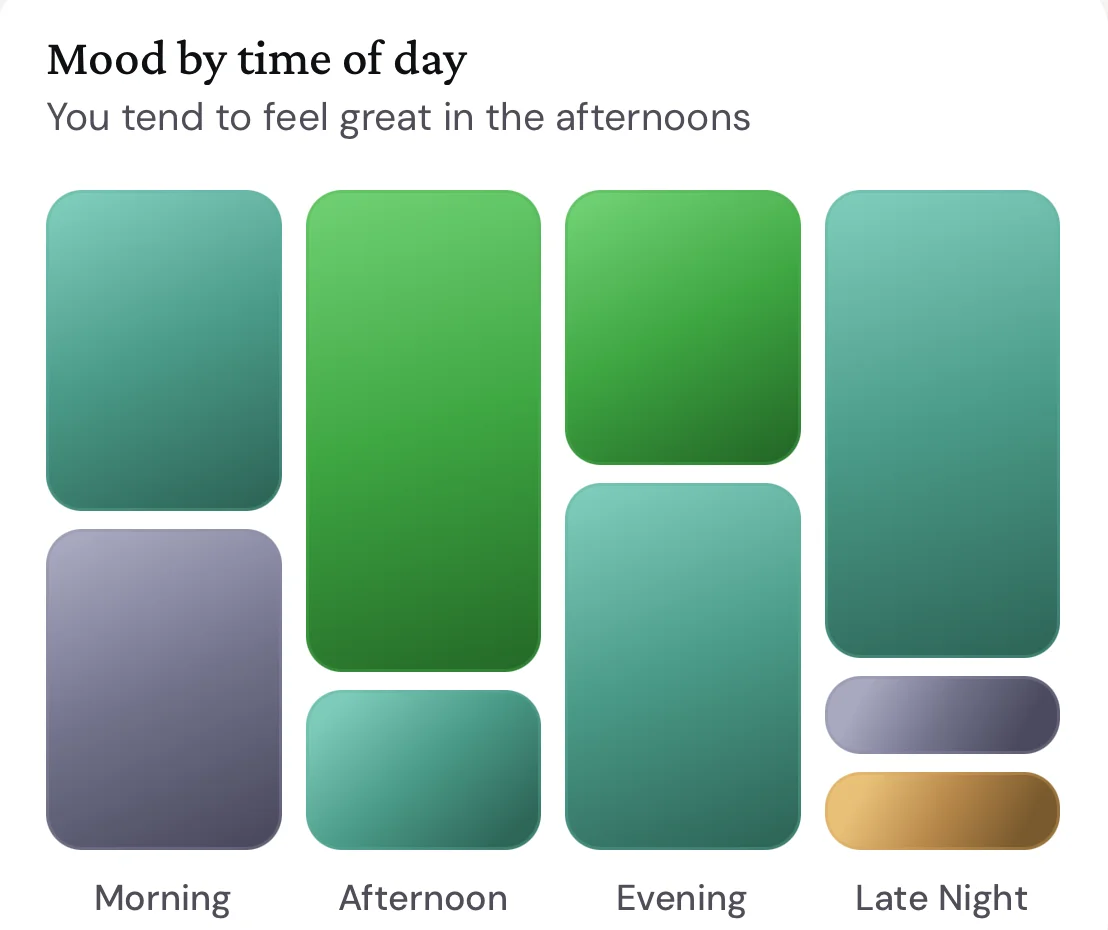
In BeSeen, each of you checks in daily with a mood, the feelings behind it and a note, choosing how much your partner sees. On Sunday the weekly recap for two shows the week’s shape side by side, so “you were low Tuesday to Thursday” is on screen before you sit down. The partner side needs an account.
Try it free on iPhoneMaking it stick
- Sunday evening is the default because the week is complete and the next one is visible. Move it if Sundays are already heavy.
- Attach it to something you already do. After the Sunday dinner dishes. On the walk. During the drive home from the in-laws, if you are brave.
- Rotate who leads. The leader keeps time and asks the questions. Swapping weekly stops it belonging to one of you.
- Long-distance: same slot, on a call, camera on. It becomes the anchor of the week. Our long-distance rituals guide has the rest.
Common questions
How long should a weekly relationship check-in take?
Twenty minutes, thirty at most. Longer than that and it becomes something you avoid.
What should a weekly relationship check-in include?
Four parts, in this order: appreciations, one hard thing each, the week ahead, and a close. Appreciations go first so the hard thing lands on a cushion; logistics go near the end so the meeting does not turn into a calendar review.
What if my partner thinks a weekly check-in is cheesy?
Drop the name. Call it Sunday coffee. Do the appreciations and the one hard thing, skip the rest, and let the results argue for it.
What if the check-in keeps turning into a fight?
Shrink it. Appreciations only for two weeks, then add the one hard thing back with the questions-before-solutions rule. If it still blows up every week, bring in a couples therapist, who will run a better version of the same meeting.
Do we need a template or an app for a weekly check-in?
For the weekly meeting, no. A shared note with the four headings is enough. For the daily check-in that feeds it, an app helps because it removes the part where someone has to remember to ask.
Walk into Sunday already knowing how their week went: a 30-second daily check-in each, and a weekly recap for two to start from.
BeSeen is a couple mood journal for iPhone. Free to try; partner features need an account.
Get BeSeen on the App Store