Feeling Unseen in Your Relationship: Why It Happens and What to Say
Updated By the BeSeen team
We make BeSeen, a couple mood journal, and mention it where it fits. How we research and write

Feeling unseen in a relationship means your inner life, your moods, worries and small wins, is not being noticed or asked about by the person closest to you. It is different from feeling unloved. Most people who feel unseen are with a partner who cares; the caring has just stopped being visible in daily attention. The fix is rarely a big conversation. It is a small, repeatable way of showing each other how you actually are.
This page covers how to recognise it, why it happens to couples who love each other, exactly what to say, and a ritual that makes being seen a habit rather than a hope.
What feeling unseen actually means
Being seen is having your internal state accurately noticed by someone else, without having to perform it. It is your partner clocking that you are quieter than usual and asking, rather than you announcing it. Relationship researchers call the same thing responsiveness: does your partner notice, understand and respond to what is going on with you. In a diary study by Jean-Philippe Laurenceau, Lisa Feldman Barrett and Paula Pietromonaco, people rated how close they felt after everyday conversations; closeness came from sharing and from feeling that the other person responded, and sharing feelings mattered more than sharing facts (Journal of Personality and Social Psychology, 1998). Those were everyday interactions, not only couples, but it is the mechanism in plain view: feeling seen is built from being responded to.
The important part: it is a two-way failure of information, not a one-way failure of love. Your partner cannot respond to what they cannot see, and most of us have become very good at hiding. It runs both ways: if you are unsure how they are, our guide on reading whether your partner is happy covers how to ask.
Six signs it is happening to you
- You edit yourself before you speak. You round “I’m drowning” down to “busy week” because the full version never seems to land.
- “How was your day” has become a formality. The question gets asked. The answer is “fine.” Neither of you expects more, and neither of you pushes.
- Your partner is surprised by things you have been carrying for weeks. The stress at work, the thing with your sister, the health worry. When it finally comes out, they say “why didn’t you tell me?” You did, in pieces. Nobody caught them.
- You feel more understood by a friend, a coworker or a chatbot. Not because they know you better, but because they ask a follow-up question.
- You have started keeping score. Who asked last, who noticed, who remembered. Score-keeping is what loneliness does when it is tired of waiting.
- Being physically close feels strangely lonely. Same couch, same bed, separate weather. This is the sign people find hardest to say out loud, because from the outside everything looks fine.
Why it happens to good couples
The “fine” loop. Early on you told each other everything, because everything was new. Years in, you both default to “fine” to save energy, and the other person learns that “fine” is the whole answer. Each of you is waiting for the other to go first. Our guide to what to say when they say “I’m fine” has replies that make the next answer easier.
Missed bids. John Gottman’s research on couples found that partners make constant small bids for attention, a sigh, a comment, a look up from the phone. In his study of newlyweds, the couples still married six years later had turned toward those bids 86% of the time; the couples who divorced, 33% (The Gottman Institute). Unseen is what a long run of missed bids feels like from the inside. Nobody missed them on purpose. They were quiet, and life was loud.
Attention debt. Kids, jobs, a sick parent, a phone that never stops. Attention is a finite budget, and the person you are surest of is the one who gets the leftovers. This is normal. It is also exactly why the leftovers need to be scheduled.
Different languages of noticing. One of you shows care by asking questions. The other shows it by fixing the tap and making the coffee. Both are real. Only one of them makes a person feel seen, and it is usually not the tap.
What to say, word for word
Say it early, say it small, and say it as information about you rather than a verdict about them. The conversation goes badly when “I feel unseen” is heard as “you are a bad partner.” These openers keep the two apart.
Opening the topic
“I want to tell you something that is about me, not a complaint about you. Lately I have been feeling unseen, and I miss feeling close to you.”
When they get defensive
“I am not saying you do not care. I am saying I have been hard to see, and I want us to fix the seeing, not argue about the caring.”
Asking for something concrete
“Could you ask me one real question about my day tonight, and could I do the same for you? Just one.”
When you are the one who missed it
“I think I have been missing you. Tell me one thing from this week that I did not notice.”
Pick a moment when neither of you is depleted, which usually rules out the end of a bad day. Then ask for one concrete thing, not a personality change. Our guide on talking about feelings without it turning into a fight covers what to do when they shut down. If they rarely open up at all, start with what to do when your partner keeps feelings to themselves.
The ritual that makes being seen a habit
Talking about it once does not fix it. Being seen is a daily supply problem, so the fix has to be daily and nearly free. The ritual that works for most couples is a check-in that takes about a minute:
- A mood, honestly. One word or one tap. “Low” is a complete answer, and it is the answer “fine” has been hiding.
- One line of why. “Work was relentless and I skipped lunch.” Enough that your partner has a map instead of a mystery.
- One question, both of you. The same question, two answers. Specific beats broad. We keep 60 of them here.
Attach it to something you already do, the lights-out moment or the commute call. The full version is in our daily relationship check-in guide.
Why this works when talking did not: it removes the part where one of you has to notice. A mood your partner can see without asking is a bid that cannot be missed.
In BeSeen
A bid your partner cannot miss
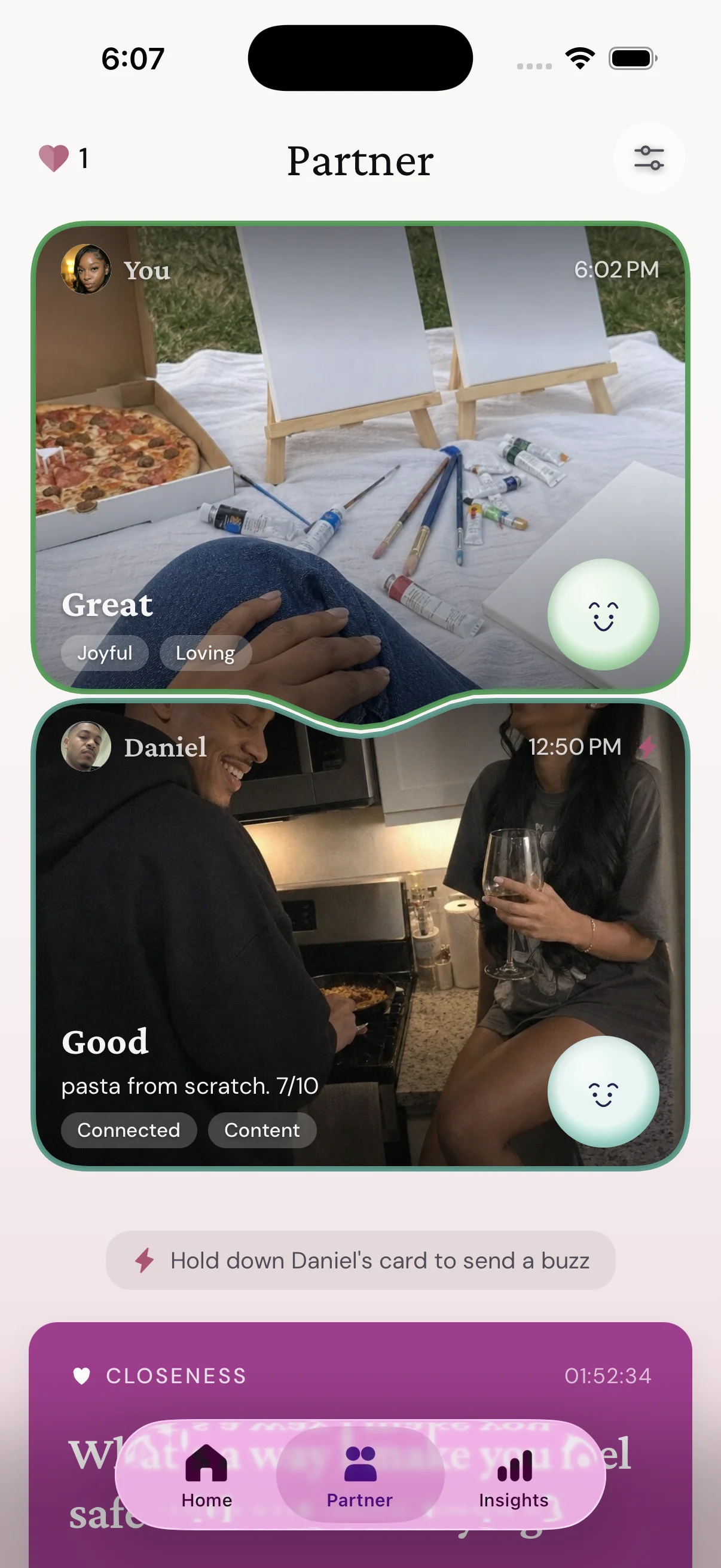
In BeSeen, you check in with a mood and the feelings behind it in about thirty seconds, and choose how much your partner sees: just the mood, a summary, or everything. It lands on their phone and home-screen widget, so “how was your day” can start from what they already saw. Solo journaling needs no account; partner features do.
Try it free on iPhoneWhen it is more than a rough patch
Feeling unseen is often a season, and a daily ritual that both of you keep can turn it around. It is worth more help when one of these is true:
- You have said it clearly, more than once, and nothing changes.
- Being seen is met with contempt, mockery or being told you are too much.
- You have stopped wanting to be seen by them, and that feels like relief.
- You feel unseen everywhere, not just at home, which points at something a couples app cannot fix.
A couples therapist is the right next step for the first two. A therapist of your own is the right step for the last one. Neither is a failure. Both are faster than waiting.
Common questions
Is feeling unseen the same as feeling unloved?
No. Unseen is about attention; unloved is about care. Most people who feel unseen are loved by someone who has stopped noticing. Saying the difference out loud, "I feel unseen, not unloved", often makes the conversation safe to have.
How do I tell my partner I feel unseen without starting a fight?
Say it as information about you, not a verdict about them, at a calm moment, and ask for one small concrete thing: "Could you ask me one real question about my day tonight, and I will do the same for you?" A request for a behaviour is easier to hear than a complaint about a personality.
What if I am the one who stopped seeing my partner?
Say so. "I think I have been missing you. Tell me one thing from this week I did not notice" is one of the most repairing sentences in a relationship, and a daily check-in works in both directions.
Can an app help with feeling unseen?
An app cannot make someone care. It can remove the friction between caring and noticing, by putting how you feel where your partner will see it without either of you having to start the conversation.
How long does it take to feel seen again?
It varies. Many couples notice a first good moment within days of starting a daily check-in, when a partner asks about a low day before it is mentioned. Making it a habit takes longer, and it depends on both people keeping it up.
Let your partner see how you are, without waiting for them to notice.
BeSeen is a couple mood journal for iPhone. Free to try; partner features need an account.
Get BeSeen on the App Store