How to Know If Your Partner Is Happy, and How to Ask Without Making It Weird
Updated By the BeSeen team
We make BeSeen, a couple mood journal, and mention it where it fits. How we research and write

The honest answer is that you cannot reliably read a partner’s happiness from the outside. You can read the signs well enough to know when to ask, like unprompted contact, small talk about their day and plans in the future tense, and you can ask in a way that gets a real answer instead of “fine”.
You are probably here because something feels slightly off, or because it feels fine and you would like to be sure. Either way, this guide covers both halves: the signs, and how to ask.
Why is it hard to tell if your partner is happy?
The people we live with are the people we stop looking at. Familiarity turns a face into wallpaper, and the partner who once noticed every shift in your mood now notices the big ones only. Add the fact that most adults are good at looking fine, and you get the common situation: two people who love each other, each privately wondering how the other one really is.
There is also a bias in the question. When we are unsure, we tend to read neutral as negative. A quiet evening becomes evidence. So before you scan for signs, know that your baseline is probably a little pessimistic, and that the fix is a conversation, not better detective work.
What are the signs your partner is happy?
None of these prove anything alone. Together, over weeks, they are a decent picture.
- They tell you small things. The annoying coworker, the song they heard, the thing the dog did. People narrate their day to the person they feel safe with. Silence about the small stuff is the earliest change.
- They reach for you without a reason. A hand on your back passing in the kitchen, a text with nothing in it but a photo. Unprompted contact is the clearest sign there is.
- They still make plans in the future tense. Next summer, when we move, the thing in October. Happy partners assume you are in the picture.
- They laugh at things that are not that funny. Shared laughter runs on goodwill more than on jokes. When it is easy, the goodwill is there.
- They bring you problems, not just conclusions. "I don't know what to do about my mom" is trust. "I handled it" every time is distance dressed as competence.
- They can be in a bad mood around you. This one surprises people. A partner who lets you see them tired, cranky or flat is not performing. Performing is what people do when they are not sure of you.
Signs something is off
Again, patterns rather than moments. Everyone has a week of “fine”. If one word is most of what you get, start with our guide to what “I’m fine” usually means.
- "Fine" has replaced actual answers. Not one bad day. A pattern of one-word replies where there used to be detail.
- They are polite. Politeness between partners is often the sound of someone managing you instead of being with you.
- They are somewhere else in the same room. Phone, laptop, TV. Everyone does this sometimes. The signal is when it is the default and eye contact has become rare.
- You are surprised by their feelings when they finally come out. If the big reveal was a shock, the small versions were not landing for weeks.
- They stopped asking about you. Curiosity is the first thing to go and the last thing people notice is missing.
- Your gut has been asking the question for a while. You are reading this. That counts.
Why guessing does not work
Reading a partner without asking has two failure modes. Guess wrong and you respond to a feeling they do not have; guess right and you have taught them that you will notice without them having to say anything, which sounds romantic and slowly removes their reason to speak up. Either way the relationship ends up running on inference. John Gottman’s research on “bids” points the other way. In his study of newlyweds, the couples still married six years later had turned toward each other’s small attempts at connection 86% of the time, and the couples who divorced only 33% (The Gottman Institute). The couples who last are not mind readers; they respond to what is offered. The bid has to be made for anyone to turn toward it. If your partner rarely makes one, our guide to a partner who does not share feelings covers how to make sharing lower stakes.
How to ask, word for word
The question that fails is “are you happy?”. It is too big, it sounds like an audit, and the only comfortable answer is yes. These work better. Pick one and say it as written, then stop talking.
The direct version
“I have been wondering how you are actually doing lately, not the polite answer. On a scale from great to rough, where has this week been?”
If direct feels too big
“What was the best part of your week? And what was the part you have not told anyone about?”
If you suspect it is about you
“Is there anything I have been missing? I would rather know than guess, and I promise not to argue with the answer tonight.”
When they say they are fine
“Okay. If fine ever turns into something else, I want to be the first to hear, not the last. Can we check in again on Sunday?”
Timing matters more than wording. Ask side by side rather than face to face: in the car, on a walk, cooking. Never during a conflict and never at midnight. And do not ask while holding your phone; the question needs your whole face.
What to do with the answer
If they say something hard, your only job in that moment is to not defend yourself. Say “thank you for telling me” and ask one follow-up: “what would help?”. Fixing, explaining and reassuring can all wait until tomorrow. Tonight the answer is being heard, and if they experience that as safe, they will tell you the next thing sooner. If what they tell you is that they have been unhappy for a while, our guide to whether it is a rough patch or the end covers what comes next.
Good news deserves the same care. In four studies, Shelly Gable and colleagues found that people who shared good events felt better, and that couples whose partner usually responded with real enthusiasm reported more intimacy and daily satisfaction (Journal of Personality and Social Psychology, 2004). How you react to their best news tells them whether to bring you the next thing.
If they say they are genuinely happy, believe them and say what you noticed that made you ask. “You have seemed quieter and I wanted to check” tells them you are paying attention, which is itself the thing most people want. Our guide on how to talk about feelings with your partner covers what to do when the conversation goes further than you expected.
Make it a habit, not an interrogation
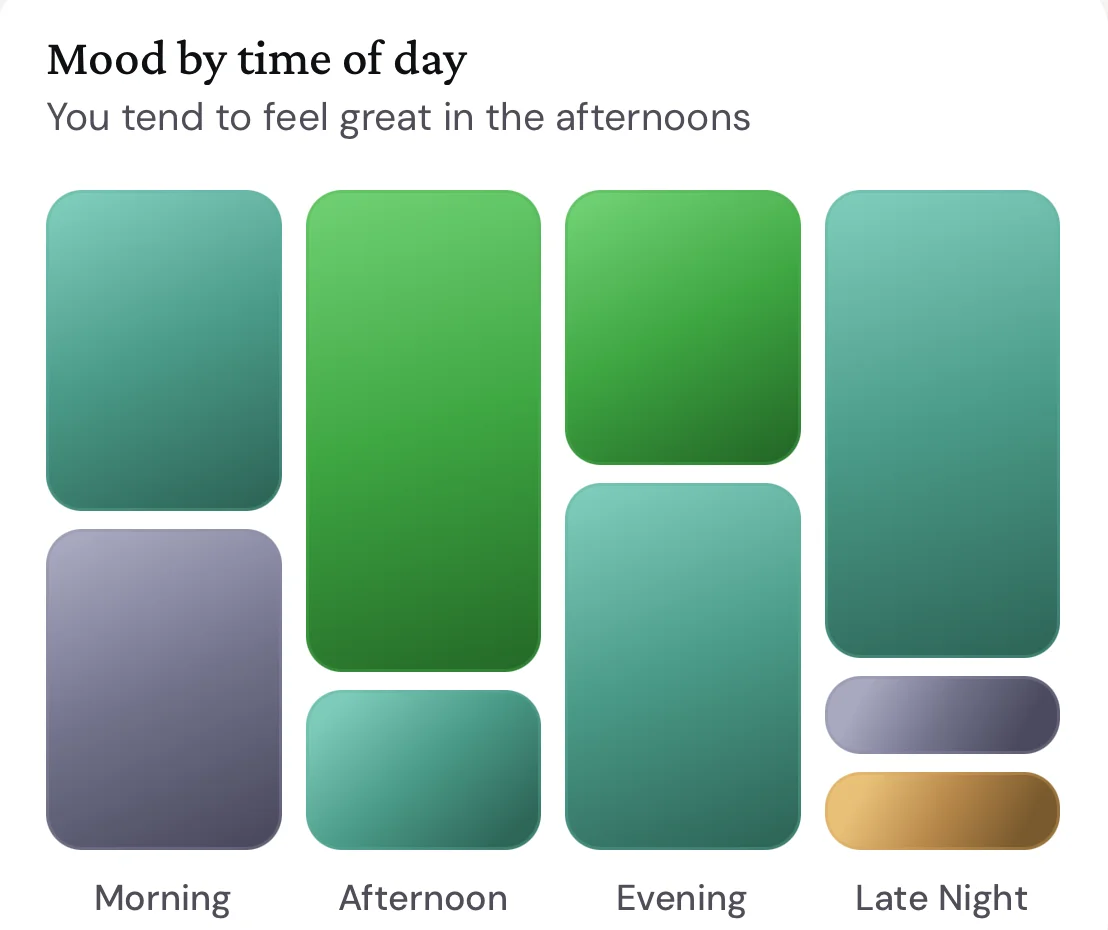
One big conversation every few months is how couples end up here in the first place. The alternative is small and boring: a daily check-in of thirty seconds, where you each say how you actually feel, on a scale, with a word or two about why. Done every day it stops being a question and becomes weather: you know it is a heavy day before you ask, and the heavy days stop surprising anyone. The daily relationship check-in explains the ritual, and the weekly version gives the bigger things somewhere to go. Kept for a few weeks, those check-ins become a shared mood tracker, and the trend is easier to trust than any single evening.
In BeSeen
See the weather, not just the day
BeSeen is built for this habit. Each of you checks in with a mood and the feelings behind it and chooses what to share, and the other’s day lands on your home screen. Over weeks, mood patterns and a weekly recap show you the trend, so one quiet evening stops looking like evidence. The solo journal needs no account, so you can start before you invite your partner.
Try it free on iPhoneWhen it is more than a mood
A few weeks of flatness, withdrawal from things they used to enjoy, changes in sleep or appetite, or a partner who says they do not feel much of anything: these are not relationship signals, they are health ones. Ask directly whether they have felt this way before and whether they would talk to someone. Offer to find the person and sit in the waiting room. If they mention not wanting to be here, take it seriously and call a crisis line together; in the US that is 988, and elsewhere your local emergency number or crisis line. The US National Institute of Mental Health has a plain-language list of depression signs.
Common questions
How do I know if my partner is happy without asking?
You mostly cannot, and the attempt is what makes people feel watched. Watch for unprompted contact, small-talk about their day, and future-tense plans, then ask anyway. The signs tell you when to ask, not what the answer is.
What if my partner says they are fine but does not seem fine?
Take the word and leave the door open. Say you would rather hear it early than late, and set a time to ask again. Many people need to be asked twice, a few days apart, before they say the real thing. Pushing in the moment usually gets a firmer fine.
Is it normal for my partner to not be happy all the time?
Yes. A partner who can be flat, tired or irritable around you is showing trust, not a problem. The concern is a pattern, weeks of polite distance, not a bad Tuesday.
How often should couples check in about how they are doing?
A thirty-second daily check-in and a longer weekly one is the pattern that holds. Daily catches the small things while they are small; weekly gives them somewhere to go.
Stop guessing how your partner is doing. Let them show you in thirty seconds a day.
BeSeen is a couple mood journal for iPhone. Free to try; partner features need an account.
Get BeSeen on the App Store