Mood Tracker for Couples: How to Track Feelings Together (and Actually Use It)
Updated By the BeSeen team
We make BeSeen, a couple mood journal, and mention it where it fits. How we research and write

A mood tracker for couples is a shared log where each partner records how they feel, usually once a day, and chooses how much of it the other person sees. Unlike a solo mood tracker, the point is not only self-awareness. It is closing the gap between “how was your day” and “fine,” so neither of you is surprised by a bad week you could have watched build.
This guide covers what to track, how to start without an app, how to read the patterns after a month, and which apps actually do the couples part well.
What a mood tracker for couples is
Solo mood trackers like Daylio ask one person to rate their day and look back at the chart. A couples mood tracker adds two things: a second person, and a decision about what they get to see. Both matter. The second person turns a private record into a conversation starter. The decision keeps it honest, because people stop logging real feelings the moment logging feels like reporting.
Good ones share three properties. The check-in takes under a minute, so it survives tired nights. Each entry can be shared at a level you choose, from just the mood to everything. And the history is readable by both of you, so patterns become something you notice together rather than something one person diagnoses in the other.
Why tracking moods together works
Two well-studied effects do the work. The first is affect labeling: in a brain-imaging study, naming the feeling in a picture calmed the amygdala, the brain’s alarm system, more than other ways of processing it (Lieberman and colleagues, Psychological Science, 2007). That is part of why “drained and a little anxious about tomorrow” feels better to say than to hold. The second is what relationship researchers call turning toward: answering the small, everyday bids for attention. In John Gottman’s research, couples who stayed married turned toward each other’s bids 86% of the time, and couples who later divorced only 33% of the time (The Gottman Institute). A mood you can see is a bid you can answer.
There is also a plain logistics benefit. Most conflicts in a long relationship are not about the thing being argued over. They are about timing, one person arriving at a hard conversation on a day the other had nothing left. A shared mood log fixes the timing problem before it becomes a fight. You know it is a “heavy” day, so the conversation about the in-laws waits until Thursday.
What to track, and what to leave out
Track less than you think. The trackers that last are the ones you can fill in exhausted.
| Track | Why it matters | Time |
|---|---|---|
| Mood level | One of five, from heavy to great. The single number that makes patterns visible. | 3 seconds |
| The feelings behind it | Two or three words. Anxious and tired is a different evening from calm and tired. | 10 seconds |
| Where you feel it | Tight chest, heavy shoulders, buzzing hands. The body notices before the mind does. | 5 seconds |
| One line of why | Not a journal entry. Enough that your partner has a map instead of a mystery. | 20 seconds |
Leave out anything that turns the log into homework: sleep scores, step counts, gratitude lists, ten-point scales. Those belong in a health app. A couples tracker is about the emotional weather, and weather reports are short. When one of you wants to write more, keep that separate from the log; our 45 couples journal prompts are a good place to start.
One addition that is worth it: a photo. A picture of the burnt dinner or the view from the train says more about a Tuesday than any tag, and it gives your partner something to reply to that is not a diagnosis.
How to set one up in five minutes
Paper or a shared note. A notebook on the nightstand or one shared note on your phones works for a week and proves the habit. Each of you writes the date, a mood word and one line. Read each other’s before bed. The limitation shows up around day ten: no way to keep some entries private, no way to see a trend, and no nudge on the nights you forget.
A couples app. The real advantage is not the chart. It is per-entry privacy and a home-screen widget that shows your partner’s mood without either of you opening anything. In BeSeen, the check-in is a mood, the feelings behind it, optionally a body map, a note and a photo, and a choice of how much to share: mood only, a summary, or everything. Solo journaling is free with no account. Connecting with your partner needs a free account; BeSeen+, with a 7-day trial, adds photos, voice and the shared canvas.
Whichever you pick, attach it to something you already do. In bed with the lights low is the classic anchor. The full ritual is in our guide to the daily relationship check-in.
Reading the patterns
After three or four weeks the log starts paying for itself. Three patterns show up for most couples:
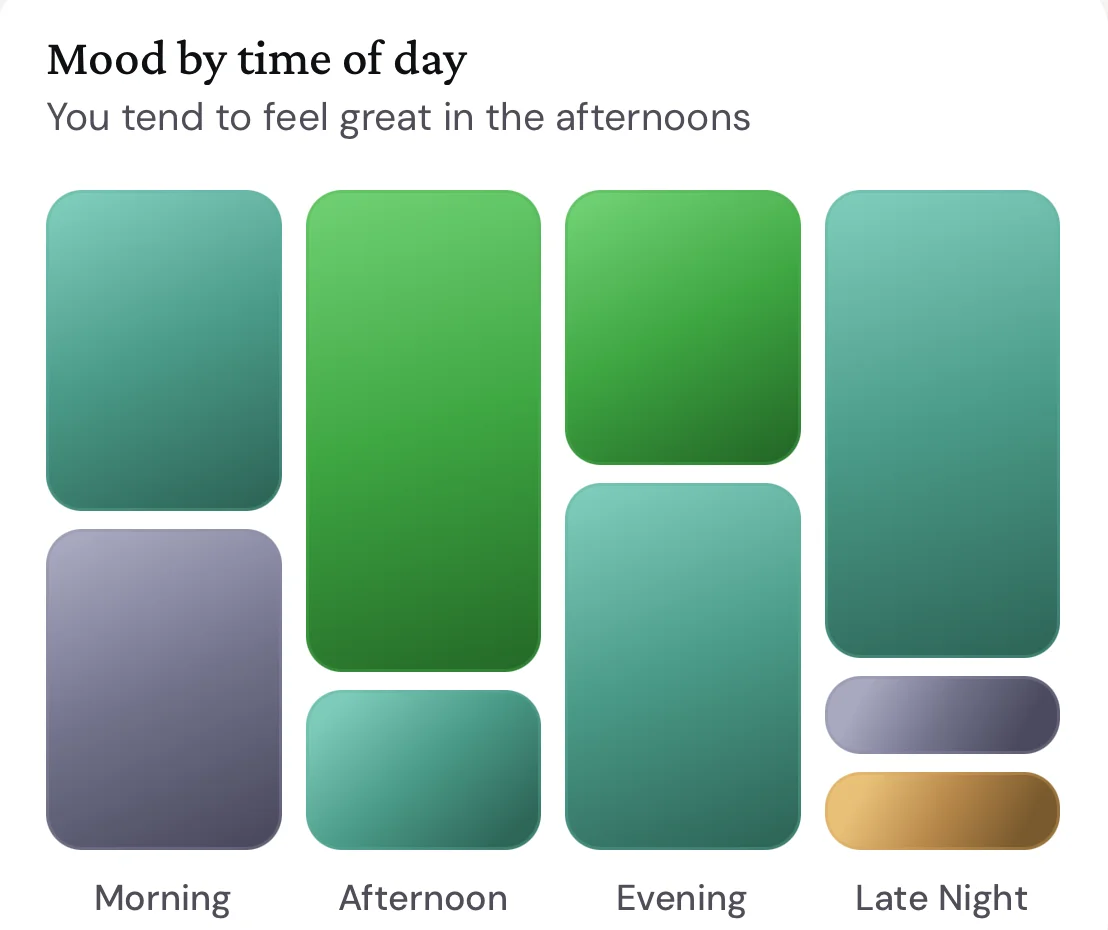
- Time of day. One of you is a wreck at 7am and fine by noon. The other crashes after dinner. Once you can see it, you stop scheduling hard conversations into the trough.
- The weekly shape. Sunday-night dread, Wednesday slumps, the Friday lift. A weekly recap for two makes the shape visible and, more usefully, makes it predictable.
- Where it lives in the body. Stress that always lands in the same place is a signal worth naming. “Your shoulders again?” is a kinder opener than “what’s wrong.”
Read patterns as weather, not verdicts. A month of “low” is information about a season, not about the relationship. The tracker is there to start the conversation, not to win it. When a pattern does need a conversation, one of our couple check-in questions is an easier place to start than the chart.
In BeSeen
Your patterns, side by side
BeSeen charts each of your moods by time of day and sends a weekly recap for two, so the Sunday dip or the 7am slump shows up on its own instead of in an argument.
Try it free on iPhoneThe sharing rules that keep it safe
A shared mood log dies the first time honesty gets punished. Four rules protect it:
- Private by default. You decide what to share, every time. If everything is automatically visible, entries get edited for an audience and the data goes soft.
- A mood is information, not an accusation. “Frustrated” does not mean frustrated at you. Ask before assuming.
- No fixing unless asked. The reply to a low day is “thanks for telling me,” not a plan.
- Low days are allowed. If every “meh” triggers an interrogation, the honest answers stop.
The same logic applies to the software. Look for an app where the note itself is encrypted so the company cannot read it, and where the privacy label does not list data used to track you across other apps. You are writing down the most intimate data you own.
Apps that do this, compared
Daylio is the best solo mood tracker, with a 4.8 rating from about 61K reviews. It is fast, chart-heavy and private. It has no partner layer at all, so couples end up screenshotting charts to each other, which works until it does not.
MoodMe is built for exactly this category: a relationship mood tracker with a partner widget and a very large emotion vocabulary. It rates 4.4 from about 440 reviews. Worth trying if you want a bigger word list than “anxious.” Check the privacy label before you commit.
Twogeta promises mood tracking with shared insights for couples. It is early, with a single rating on the US store as of the verified date, so treat it as one to watch rather than one to rely on.
Paired and the other question-a-day apps are often recommended here, but they are not mood trackers. The daily unit is a quiz prompt, not how you feel. Our comparison of couples journal apps covers them properly.
BeSeen is a mood journal first, built for two. Five mood levels with feeling tags, a body map, notes and photos, per-check-in sharing (mood only, summary, or everything), a partner widget, mood by time of day and a weekly recap for two. Check-in notes, feelings and text replies are end-to-end encrypted; mood level, photos, voice notes, love notes and emoji reactions are not, so widgets and notifications can work. iPhone only, free to try; BeSeen+ is $9.99/month or $59.99/year for both partners. It is new, so the review count is small.
Common questions
What is the best mood tracker for couples?
For tracking moods together, BeSeen (our app, iPhone): a 30-second mood check-in that lands on your partner's home screen, and each time you choose whether they see just the mood, a summary, or everything. MoodMe is another relationship mood tracker with a partner widget. For tracking only your own moods, Daylio is the most established.
Do both partners have to use a couples mood tracker?
No. One person tracking alone still gets the self-awareness and can share what they choose. The partner features are the point, though, so aim for both within a couple of weeks.
What if my partner thinks a mood tracker is surveillance?
Make the privacy real. Choose a tool where sharing is opt-in per entry, agree that no one asks why something was not shared, and start with mood-only sharing. Trust grows from the control, not from the data.
How long before tracking moods together helps?
The first useful conversation usually happens in the first week, when one of you sees a heavy day and asks about it. Patterns by time of day and day of week take about a month to show.
Does a couples mood tracker work long distance?
It works especially well at a distance, because distance removes the ambient signals you would pick up at home, like a sigh or a slammed door. A shared mood log puts a structured version of those signals back.
Start tonight: a 30-second check-in, your choice of what your partner sees, and a month from now, patterns you can read together.
BeSeen is a couple mood journal for iPhone. Free to try; partner features need an account.
Get BeSeen on the App Store