Going Long Distance for College: How to Make It Work From the First Week
Updated By the BeSeen team
We make BeSeen, a couple mood journal, and mention it where it fits. How we research and write

Many college long-distance relationships work. In a US study of 870 people, those in long-distance relationships reported relationship quality as high as or higher than people whose partner lived nearby. The ones that struggle usually stumble on things you can fix early: no agreed rhythm, unspoken rules about going out, and quiet resentment of the other’s new life.
One of you is unpacking boxes in a room that smells like paint. The other is back home, or in a different city, looking at the same photo you both took at the station. Everyone has an opinion about whether this will work. Most of those opinions are about the distance, and the distance is the least important variable. What decides it is what the two of you do in the next six weeks.
The first six weeks set the pattern
The first month of college or a new job is the most socially intense stretch of a young adult’s life. New people every day, no routine yet, and a strong pull to say yes to everything. For the partner who moved, the relationship competes with all of that. For the partner who stayed, or moved somewhere quieter, the relationship can become the main event while the other person’s life is exploding. That mismatch, not distance, is what most of the early fights are about.
The distance itself is not the verdict people make it out to be. In a US study of 870 people, those in long-distance relationships reported relationship quality as high as or higher than people whose partner lived nearby, and they were just as likely to still be together at follow-up (Kelmer and colleagues, Family Process, 2013). An earlier study of long-distance dating couples found the risk came later: longer stretches between visits and an idealized picture of each other predicted breakups once couples moved back together (Stafford and Merolla, Journal of Social and Personal Relationships, 2007). So the couples who make it through tend to do two things early: they talk about the boring logistics before there is a fight about them, and they set a rhythm small enough to keep on the worst week of the semester.
Have the boring conversation now
You do not need a contract. You need five sentences you both agree with, said out loud, before the first misunderstanding rather than after it.
- How often you talk. Not "all the time". A number. One call a day at a time that survives a lab section and a shift at work, and one longer one at the weekend. Everything else is a bonus, not a debt.
- What counts as a slow reply. Decide now that a message unanswered for three hours during the day means nothing. It is the single most common source of long-distance anxiety and it is fixable with one sentence.
- Going out. Both of you will be at parties the other is not at. Say out loud that this is fine, and say what is not fine. Vague rules get tested; specific ones get kept.
- What happens when someone is upset. The person who is upset says so within a day. No going quiet to see if the other notices. At a distance, nobody notices; they just feel far away.
- Visits and money. Who travels, how often, who pays. Students rarely have money, so a plan that alternates and uses the cheap bus is more loving than one that assumes flights.
How often should you talk?
The mistake is to design for the first week, when you miss each other and have time. Design for week seven, when there is a midterm, a cold, and a friend crisis at the same time. If the rhythm survives that week, it survives.
Every day
One check-in that takes under a minute: how the day was, in a word, and one line of why. Same time each day if you can, so it becomes an anchor instead of a chore.
Most days
One thing from your actual day. A photo of the terrible dining hall pasta, a voice note from the walk to class. Ordinary is the point; it is the ambient information living apart deletes.
Once a week
A real date with a start and end. Watch the same thing, cook the same recipe on a call, or just talk with nothing else open. Put it in the calendar like a class.
Once a month
A ten-minute honest review. What has felt good, what has felt off, whether the rhythm still fits the timetable. Adjust, do not accumulate.
Nine more of these, including ideas for brutal time zones, are in our guide to long-distance relationship rituals. If you are in different time zones, our guide to making a time difference work helps you pick a call slot that survives, and our free time zone planner shows the hours you are both awake.
Let them have the new life
The hardest thing about the first semester apart is not missing each other. It is watching your partner build a life you are not in, and not knowing the names. The instinct is to hold on harder: more calls, more questions, a little edge when they mention someone new. It reads as love from the inside and as a leash from the outside.
The move that works is the opposite one. Learn the names. Ask about the roommate’s drama, the professor who talks too fast, the place everyone goes on Thursdays. When you know their world, their world stops feeling like a competitor. And say the thing directly when you need to: “I love that you are having fun. I also need to hear from you at some point tonight.” Both halves are true and both halves are allowed.
Which fights only happen at a distance?
Three kinds, and you will meet at least one. The text fight, where a neutral message reads as cold because there is no face attached; the fix is a rule that anything that stings gets moved to a call within the hour. That rule has some backing: in a survey of young adults in committed relationships, using texts to settle disagreements or say hurtful things went with lower relationship quality, while affectionate texts went with stronger attachment (Schade and colleagues, Journal of Couple & Relationship Therapy, 2013). The keeping-score fight, where one person tracks who called last and who cancelled; the fix is the monthly review above, so it gets said before it compounds. And the phantom fight, where one of you has been upset for three days and the other has no idea, because at a distance there are no tired shoulders at the door to notice.
That last one is the quiet killer, because it does not look like a fight. It looks like drifting.
Know how each other’s day went, without the interrogation
Living together, you know how your partner’s day went before they say a word. Apart, the only way to find out is to ask, and “how was your day?” every night at eleven is a question that gets a tired “fine” more often than a real answer. The couples who stay close at a distance find a way to share the baseline without turning it into a debrief.
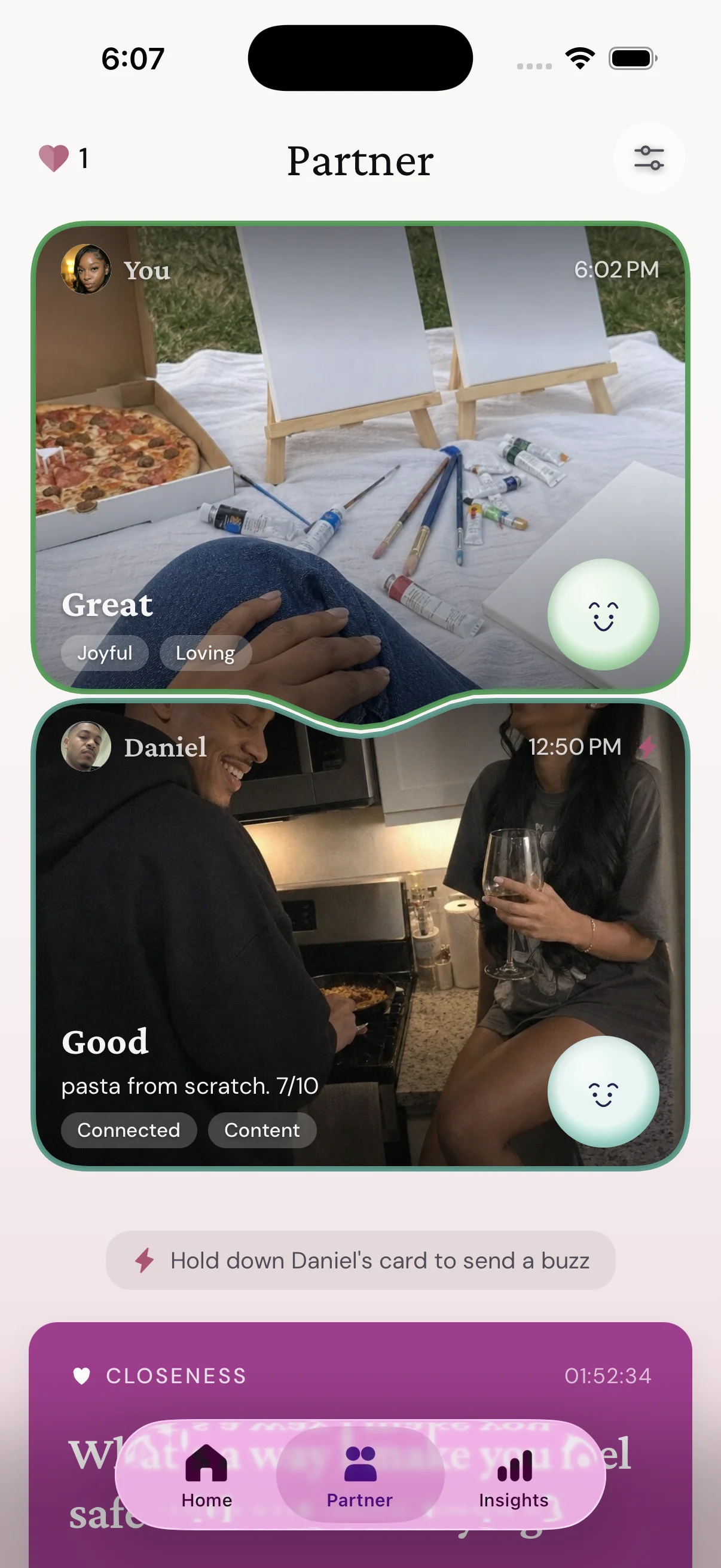
In BeSeen
Their day, without the debrief
Each of you checks in with a mood and the feelings behind it in about thirty seconds, and chooses how much the other sees. Your partner’s day lands on your home screen, so the late call can start from “I saw today was rough” instead of “so, how was it?”.
Try it free on iPhoneThe solo journal needs no account, so one of you can start and invite the other once they have unpacked. If you want to compare other tools first, our long-distance relationship apps guide sorts them by the job they do.
Plan the next visit before you miss this one
Always have a date on the calendar. It does not need to be soon; it needs to exist. A visit six weeks away turns the distance from an open-ended thing into a countdown, and countdowns are survivable (our free days together calculator counts the days down, and our countdown to the next visit makes a link you can send, so you are both counting toward the same date). Book the cheap option early, alternate who travels when you can, and when one of you cannot afford it, say so plainly instead of going quiet about it. Money silence is a relationship problem dressed up as a scheduling one.
When the visit comes, resist the urge to make it perfect. The best visits include one boring afternoon of doing nothing in the same room, because that is the thing you actually miss.
When it is not working
Sometimes the honest answer, a couple of months in, is that one of you has changed direction and the relationship is being held together by guilt about the effort already spent. Signs worth taking seriously: dreading the scheduled call, feeling relieved when it gets cancelled, or realising the only thing you talk about is the relationship itself. None of those mean you have to end it. They mean the monthly review needs to be an honest one, and that a rough patch and a mismatch are different things that deserve different conversations.
Common questions
Do long-distance relationships in college actually work?
Many do. In a US study of 870 people, those in long-distance relationships reported relationship quality as high as or higher than people whose partner lived nearby, and were just as likely to still be together at follow-up. The ones that struggle often stumble on things that are fixable early: no agreed rhythm, unspoken rules about going out, and one person quietly resenting the other's new life.
How often should college couples talk long distance?
Less than you think, more consistently than you think. A short daily check-in plus one proper weekly date is a rhythm most students can keep through exams. Talking for hours every night usually collapses in week three and leaves a gap that feels like drifting.
How do I stop worrying when my partner is out and not replying?
Agree in advance what a quiet evening means. If you both know that "out with people from my floor, will message when I am home" is the deal, silence stops being data. Most of the worry comes from not having a shared rule, not from the silence itself.
Is it a red flag if we fight more since going long distance?
Not by itself. Text removes tone, and both of you are tired and adjusting. It becomes a concern when the fights are about the same thing every week and nothing changes, or when one of you starts dreading the calls.
What is the best app for long distance college couples?
It depends on the job. For feeling each other's day, a shared mood check-in like BeSeen. For talking across time zones, an async video app. For visits and money, a shared calendar. Our long-distance apps guide sorts them by job.
Share your day in thirty seconds, from any campus or city.
BeSeen is a couple mood journal for iPhone. Free to try; partner features need an account.
Get BeSeen on the App Store